[Click the image for a larger view]
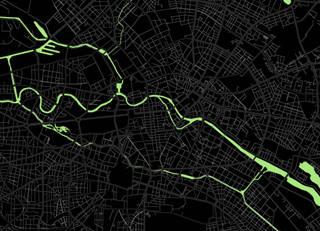
The design is simple but poignant. Roads are color-coded and layered at scale, one on top of the other. Silhouettes correspond to the real configuration of the routes, so you get a good sense of not just size but of geography. The whole thing looks like a Georgia O’Keeffe flower -- which is probably the last thing that springs to mind when you think of endless tracts of asphalt in say, Atlanta, or Beijing.
Not all Global Cities are created equal. We can hope the developing-world metropolises of the future will look a lot like the developed-world cities of today, just much, much larger -- but that's not likely to be the case. Today's Third World megacities face basic challenges in feeding their people, getting them to and from work, and maintaining a minimum level of health. In some, like Mumbai, life expectancy is now at least seven years less than the country as a whole. And many of the world's largest advanced cities are nestled in relatively declining economies -- London, Los Angeles, New York, Tokyo. All suffer growing income inequality and outward migration of middle-class families. Even in the best of circumstances, the new age of the megacity might well be an era of unparalleled human congestion and gross inequality.
Perhaps we need to consider another approach. As unfashionable as it might sound, what if we thought less about the benefits of urban density and more about the many possibilities for proliferating more human-scaled urban centers; what if healthy growth turns out to be best achieved through dispersion, not concentration? Instead of overcrowded cities rimmed by hellish new slums, imagine a world filled with vibrant smaller cities, suburbs, and towns: Which do you think is likelier to produce a higher quality of life, a cleaner environment, and a lifestyle conducive to creative thinking?
Augmented City 3D from Keiichi Matsuda on Vimeo.
Keiichi Matsuda, a recent graduate—with distinction—from the Bartlett School of Architecture, whose film Domestic Robocop was featured on BLDGBLOG several months ago, has a new project out: Augmented City. And it's in 3D.The film "focuses on the deprogramming of architecture and the spontaneous creation of customised, aggregated spaces," Matsuda writes. We see its central protagonist surrounded by pop-up menus and projected touchscreens, able to switch urban backgrounds—graffiti to gardens—in an instant.

The 21st century will not be dominated by America or China, Brazil or India, but by the city. In an age that appears increasingly unmanageable, cities rather than states are becoming the islands of governance on which the future world order will be built. This new world is not — and will not be — one global village, so much as a network of different ones.
Now as then, cities are the real magnets of economies, the innovators of politics, and, increasingly, the drivers of diplomacy. Those that aren’t capitals act like they are. Foreign policy seems to take place even among cities within the same country, whether it’s New York and Washington feuding over financial regulation or Dubai and Abu Dhabi vying for leadership of the United Arab Emirates. This new world of cities won’t obey the same rules as the old compact of nations; they will write their own opportunistic codes of conduct, animated by the need for efficiency, connectivity, and security above all else.
Watch also Parag Khanna's TED talk about the shape of future countries.
Hi. My name is Anna Lena. I'm on a quest for finding the perfect city. Kinda like Indiana Jones in The Last Crusade searching for the Holy Grail, just the urban female version.

I'm a country girl, born and raised, and like many of us "Landeier" I've taken to the big city as soon as school was finished. I spent my 20's in various parts of this world, wandering, studying and working. Most of the destinations I've travelled to have been urban areas. Now I'm facing the next decade of my life and I've found out that I'd like to settle for a while. The only question is - where? In a city, that's for sure. I liked a lot of the places I've been at, but something has always been missing.

via flickr
Over the past decade, the development of digital networks and operations has produced an unprecedented wealth of information. Handheld electronics, location devices, telecommunications networks, and a wide assortment of tags and sensors are constantly producing a rich stream of data reflecting various aspects of urban life.
This constant stream of 0s and 1s allows unprecedented research opportunities. Through phone calls we can see cities making bold ‘handshakes’ during business hours, and then becoming introverted during the evening. With SMS texts, we capture crowds cheering and sharing their emotional highs in special events. These digital traces also reveal the migratory magnetism of coastal city hotspots and the drudgery of a gridlocked commute.
The 'Network & Society' project at the MIT Senseable City Lab employs these large-scale digital datasets to explore physical mobility, social networks and urban places.
It's called PARK(ing) Day! Citizen Activists around the globe turn parking spaces into mini-parks for a day to demonstrate the need for more urban green space. The annual event is organized online, but staged offline in dozens of cities on every continent around the world. It's a demonstration of the power of social media and international collaborative activism... and a great way to have fun and relax.
The next PARK(ing) Day is te 17th of September - start organizing your event now!
Those smart parking solutions that everybody is talking about are here. San Francisco is an obvious testing ground for those kind of solutions with its tech savvy population. Especially the pricing solution is intriguing, it will be interesting to see, if it really scales.
Ignite presentations are often very good, but this one is of the chart. The work that Mark has put into this presentation is just incredible. And it's funny too. Thanks to Fernando for finding this.
Despite the silly picture and the eccentric "3D Express Coach" branding, this cunning project by Shenzhen Huashi Future Parking Equipment actually makes sense. The idea is to make use of the space between regular-size cars and bridges, thus saving construction costs as well as minimizing congestion impact by allowing cars to drive underneath these jumbo buses.